
$80M in Working Capital Was Hiding in Plain Sight

Hello all,
It's been another busy week here at Crawford McMillan HQ as strong signs of spring begin to emerge and the first daffodils tentatively poke up from the soil.
I was excited to reunite with my old friends from Snowflake at their Data for Breakfast event in Tyson's Corner, VA. All the coolest tech was on show with the new Cortex code feature which, despite the almost-traditional live demo wobbles, had most of the crowd very impressed. We're already implementing this with clients, so there are fewer surprises here, but I'm excited to see 'talking directly to your data' become a standard capability.
As more and more AI news, features, and capabilities emerge, it's becoming apparent that keeping up with everything is almost a full-time job in itself. Let me know if you've found any gems in between meetings!
Enjoy the rest of this week's memo.
Three Things I Learned This Week
For One Thing To Begin Another Must End
I've been enjoying a series of podcasts about transitioning through life phases. Nothing morbid, I promise, but there's this interesting concept of an ego death that must be embraced before a new phase of life can be unlocked.
It particularly resonated with me in relation to my transition from corporate to running my own company over the last two years, but it also applies to companies undergoing any sort of digital transformation.
As well as that as a company transitions to become a PE-backed company, the things which they are measured on, the expectations and the priorities also shift in a way that requires a form of ego death.
Food for thought as I continue conversations to set up clients and prospects in the best way possible for whatever transition they are approaching.
Working capital is not a back-office metric. It is a strategic lever.
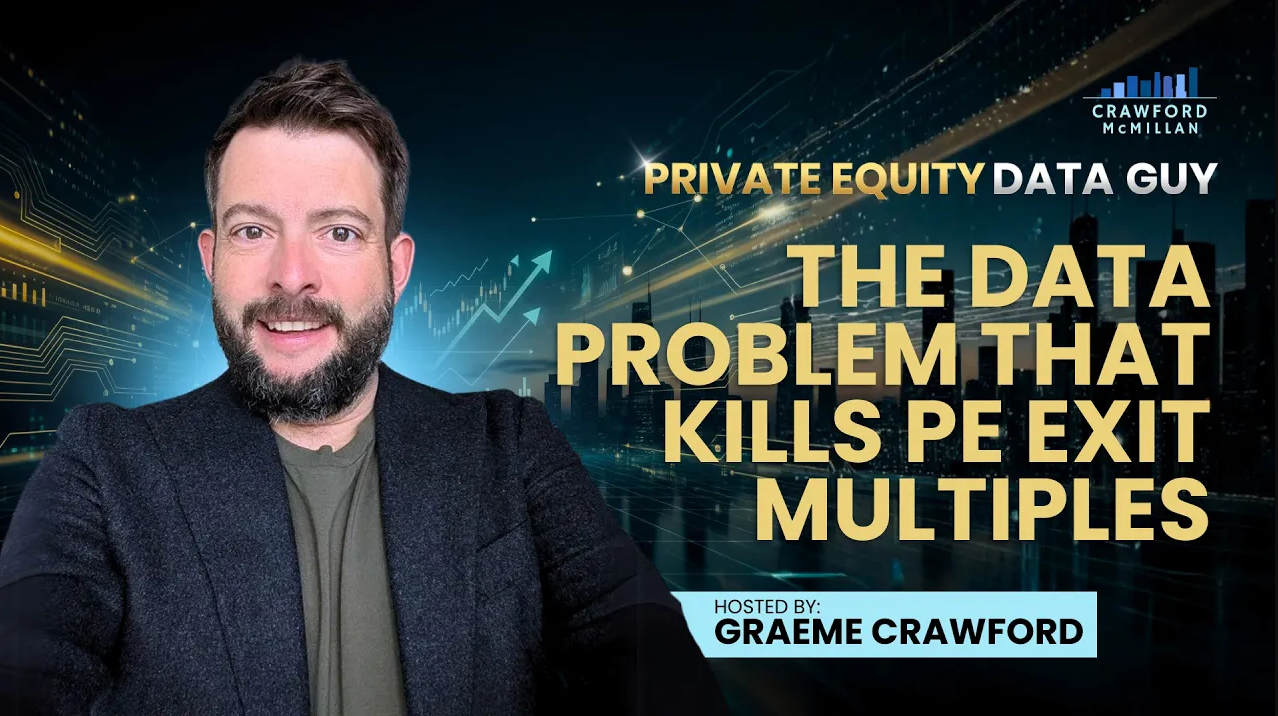
This week on PE Data Guy, I sat down with Shota Ishii, founder of Prossimo Tech and one of the sharpest minds I've met at the intersection of data and capital efficiency. Shota's path is unusual. He came up through quantitative finance, ran a hedge fund that Blackstone Credit eventually acquired, built an AI and machine learning lab inside a bank, and then turned all of that toward one of the most overlooked problems in PE-backed manufacturing: figuring out which products are actually making money.
We get into how his team helped a $400 million metals company find $80 million in working capital in three months, what a "robo CFO" actually looks like in practice, and why most mid-market AI initiatives stall before they start. If you care about where data meets value creation in portfolio companies, this one is worth 45 minutes of your time. Watch the full episode here.
AI projects fail 96% of the time when used against data with no semantic model
I got this joyous stat from the Snowflake Date for Breakfast event. Totally unsurprising to me, but they dug further into AI projects that succeeded and failed and found a high failure rate when the semantic data layer was not properly established before AI was applied.
Once that was established, success rates did improve to nearly 50%, although more than 50% still failed. I talk a lot about the data angle on here, and while that is obviously a very important one, it's clear that other success factors are also at play for AI initiatives.
Two News Stories From This Week in Mid-Market PE & Data
AI Fears Temper Interest as PE Firms Weigh Data Company Deals
FactSet down 39%. Morningstar down 28%. Gartner down 30%. All since September. PE firms like Thoma Bravo and Hellman & Friedman are stepping back from data company acquisitions because no one can confidently model the impact of AI substitution on these businesses over a five-year hold. The irony is that these are exactly the kind of sticky, subscription-revenue companies PE has loved for a decade. What changed is that buyers now have to answer a question they've never had to answer before - will AI replicate the product your revenue depends on?
If you're running a portfolio company whose value rests on proprietary data or analytics, this is your early warning. The buyers at your exit will be asking the same question about you.
Story 2
Bain and StepStone Release 2026 Private Equity GP Outlook
Nearly 40% of GPs surveyed expect no material financial impact from AI within their portfolio companies this year. Meanwhile, AI is showing real ROI in deal sourcing and due diligence, where the data is already structured, and the workflows are already defined. The gap is obvious. AI works where the data is clean. It stalls where it isn't.
If you're an operating partner wondering why your AI initiatives aren't translating into EBITDA improvement, the answer is almost always upstream. Your data isn't ready. The report also confirms what the market already feels: 79% of GPs expect multiples to plateau, continuation vehicles are surging, and dry powder is sitting at $1.18T. The exit environment rewards companies that can prove their numbers. That starts with data.
Free Tool of the Week - The Buyer's Private Scorecard
When a buyer's data team opens your data room, they are not browsing. They are scoring. Every sophisticated acquirer has an internal rubric, formal or informal, that grades the quality of what they find. The score drives how hard they negotiate, how much risk they price in, and whether they walk.
This scorecard is built from patterns across dozens of mid-market transactions. The categories, the rating criteria, and the buyer commentary reflect what actually happens in diligence, not what advisors tell you in pitch decks.
Check it out here.
Sign-off
If this resonates and there's something you think we can help with, just reply to this email. We read everything that comes through.
As always, please forward this on to your favorite substantially PE-backed friend.
Cheers,
Graeme