AI policy without enforcement is just another PDF

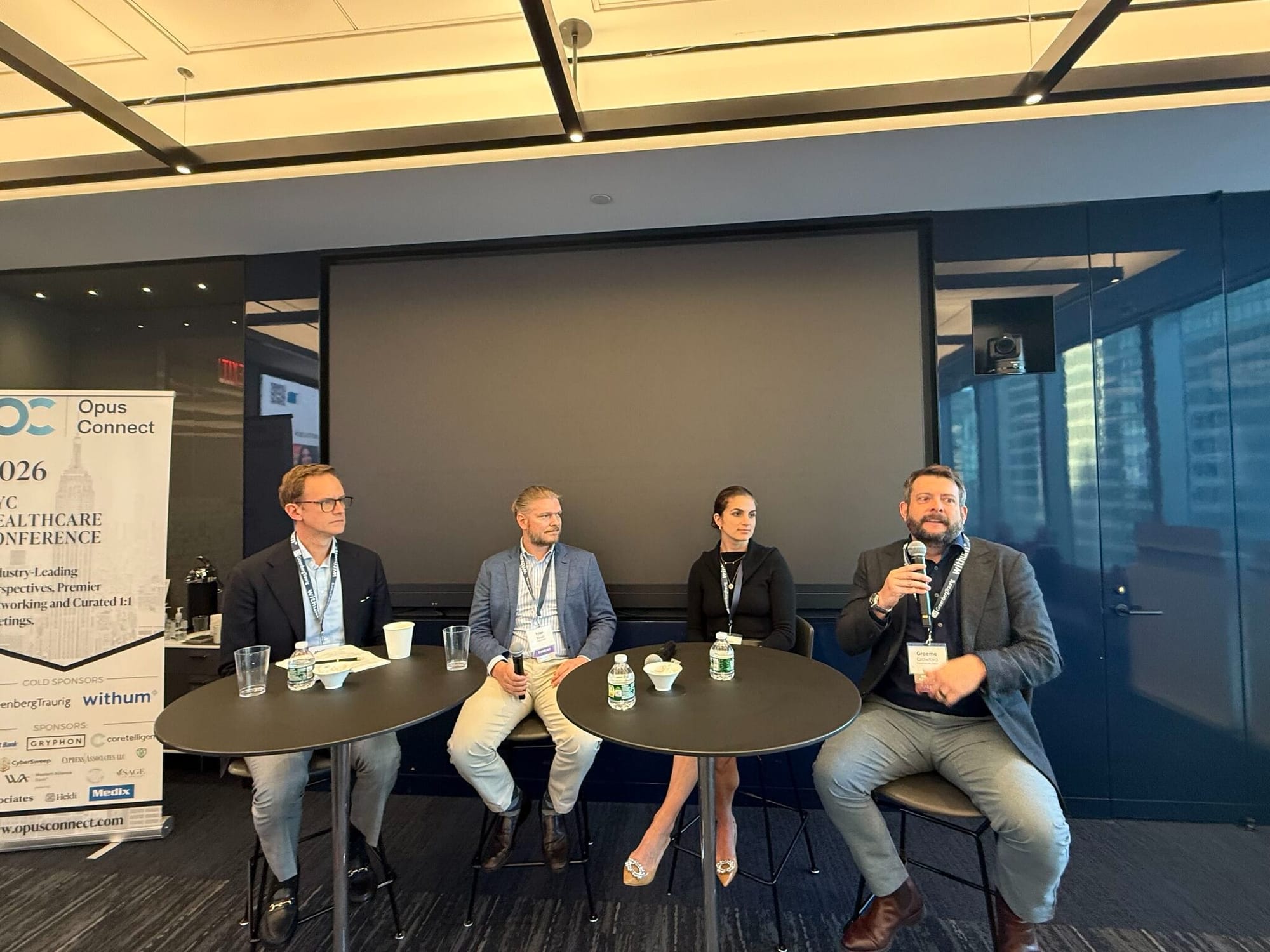
I’ve was in NYC last week, speaking on the AI panel at Opus Connect PE Healthcare Conference and visiting clients.
The panel itself was excellent, even though all 3 panels before us inevitably ended up as an AI conversation, the titling and focus was done well enough that they didn’t feel repetitive.
Mid-term results came up a lot as you’d expect with the timing - but even in a healthcare industry expected to see some impact from the change of congressional control the vibes were very much ‘wait and see’.
In-person events are expensive and both PE and NYC are multipliers of that cost, but I remain convinced that the right ones are worthwhile. I’ve got 3 solid follow-ups booked for next week and got a lot of great exposure to my client base along the way.
Social highlights of the trip including catching the Tony-award-winning “Maybe Happy Ending” (excellent, and a zero-interval/7pm start for those who like to be in bed early) and an outstanding dinner at Empellon - my highlight was the confusingly wonderful ‘corn ice cream taco’.
Further on the bizdev front, I’m excited for our new outbound SDR to get started this week. Excited to see how this new channel works out for us with our plan to start 2027 strong with some exciting new clients joining the roster.
I can’t believe it’s November already - another year flies by…
Enjoy the rest of the memo!
Three Things I Learned This Week
He mandated AI, then could not say where it was being used
This week’s PE Data Guy guest is Phil Murphy, President and CEO of Synergy ECP. Synergy is owned by Falfurrias Capital Partners and does engineering work for defense and intelligence customers, with about 240 people and about $100 million in revenue. I first heard Phil on an ACG National Capital panel, where he said he had not piloted AI in the back office, he had mandated it.

Watch this week’s episode of PE Data Guy, with Phil Murphy
His view of pilots is short. “Pilots are organizations declining to decide.” Nobody enforces the deadline, and the report at the end holds a promise.
The mandate itself was simple. Every functional leader had to take one core recurring workflow, real work and not a demo, run it with AI, and come back with the baseline they started from. It had to run on a sanctioned path so the company could see it. He left the how to them. The people doing the work know where the friction is.
The technology worked on day one. What broke was the process underneath it. “AI is a mirror,” he told me. It can only run a process you can describe, on data it can find. Staffing was his example.
The same function with the same job titles was running different processes from one team to the next. So the mandate grew a second rule, one process and one data structure per function.
The pushback came from the functions with the most tribal knowledge, and it had little to do with the tools. For years people had been judged on output and effort. Now cycle times and exceptions would be on show.
He put it this way. “Resistance to AI is almost never about the model. From an employee’s perspective, it’s about their work becoming visible. From an organization’s perspective, it’s about visibility into what AI is doing.”
Then his COO asked a plain question. Where is AI being used in this company, and on what data? Phil had mandated it everywhere and he could not answer. There were dozens of tools, each with its own console, and no record he could hand to anyone. Nobody had done anything wrong. They had done what he asked.
So Synergy built the record, and last month it launched it as a product called Watchfloor. He describes four parts. An inventory of the tools and agents in use. A log of every request. Policy that is enforced, because “policy without enforcement, it’s a PDF.” And evidence, a trail you can hand to an auditor or a diligence team without a three-week fire drill.
When they turned the lights on they found personal accounts and spreadsheets uploaded to public models. He punished nobody. He made the sanctioned path easier than the workaround. “Shadow AI is a demand signal. It’s not a discipline problem.”
I asked how this plays with his sponsor. Nobody on his board has asked whether AI cut cost. They watch G&A as a percentage of revenue, and how much more of it the next dollar of revenue needs. He expects a buyer to run the same test. “The multiple isn’t paid for what you cut. It’s paid for how far ahead you can see.”
One thing to take into Monday. Ask your own COO’s question. If nobody can say where AI is being used and on what data, you have Phil’s problem without his record.
Watch the full conversation here.
Lenders have stopped underwriting the synergies
Last Wednesday I was at Opus Connect’s healthcare conference in New York, on a panel of my own and in the audience for the rest. The sharpest thing I heard about roll-ups came from the credit side of the room.
Stephanie Perry is a Managing Director at Brightwood Capital, a private credit firm. She described physician practice roll-ups done at very high leverage where “a lot of the synergies didn’t materialize.” Those companies now carry too much debt and their sponsors cannot sell them.
Lenders, she said, are no longer underwriting the synergies at all. They ask how the companies are put together in practice, and what they keep finding is that the systems everyone assumed would be built were never built.
Stan Glezer of Outcome Capital, an investment banker and a physician, gave the deal-side version. To judge whether combining providers creates value, you have to look at the data they manage. “If you ever try to integrate two instances of Epic,” he said, “you know how painful that is.”
Before the deal the usual answer is that someone will figure it out. Leave it long enough, he warned, and it can derail the profit assumptions in the model. He expects the ability to manage data consistently across merging providers to become a key diligence point.
Alex Rich of Converge Health Partners, an independent sponsor, described the constraint. In the founder-led companies he buys, “you can make one hire in the first year.” On his most recent deal that hire was a sales leader. I have not yet met the sponsor who spent it on the person who makes two systems agree.
Phil Murphy told me the same story from the buyer’s seat, with a better ending. Once every function ran one process on one data structure, an acquired company stopped being a headcount problem and became a data problem. “Data problems at least have a known playbook.”
If your value creation plan has a synergy line in it, ask who is building the systems it depends on, and by when. Your lender will ask at the next refinancing.
The model is the part you can swap
On my own panel I made a point about AI models.
Mid-market companies spend too long choosing an AI model. The models overtake each other every few weeks. What I tell clients is to keep the company’s own knowledge, its definitions and its documents, on its own systems and outside any one vendor’s memory. Then moving from one model to another is a small job.
Jessie Young, who runs North America for Heidi Health, came straight back. Relying on a single model, she said, is “definitionally foolish” and a bad use of your inference budget. She added that nobody loves their data layer, and that the value sits in what you do on top of it.
I agree with her on both, and neither was the point I was making. Mine was about where the company’s knowledge lives. Hers was about how many models you run. They are one argument seen from two ends. You can only run several models, or change one, if what the company knows lives somewhere you control.
Phil Murphy had said it to me on the podcast a week earlier. If a customer told Synergy to stop using one provider tomorrow, the move should be routine, because the structure and the data sets are what matter and the model sits on top.
A test you can run this week. Ask what it would take to move your most-used AI workflow to a different model. If the answer is a rebuild, the knowledge is in the wrong place.
Two News Stories From This Week in Mid-Market PE and Data
33,853 companies are waiting for a buyer
Source. Fortune, Nov 6
What happened
JPMorgan’s global head of M&A, Charlie Bouckaert, told Fortune he expects 2027 to be a quieter year for deals overall and a busier one for private equity exits. His reason is the clock. Holdings are ageing and investors want their money back, and some of those companies will need to refinance in 2028 or 2029. The private equity model, he said, “is reliant on exiting and returning capital to LPs. And so that’s going to have to happen.”
PitchBook figures reported by the Wall Street Journal put the stock of unsold private equity investments at 33,853 at the end of September, up from 33,575 in June. Bain has buyout holding periods at around seven years, against five to six between 2010 and 2021.
Why you should care
A sale that happens because the clock ran out is a sale on the buyer’s terms. On another panel in New York last week, Omer Ahmed of Echo Health Ventures gave the buyer’s side. Whoever buys your company expects to sell it again in five years, to someone with a five-year model of their own, so they are looking for a business with “10 years of staying power.” The companies that can show that on paper will clear first. The rest wait with the other 33,852.
Read the Fortune piece here.
A sell-side adviser tells owners to reconcile their KPIs
Source. Carlsquare Private Equity Insights, Q3 2026, Nov 4
What happened
Carlsquare, a corporate finance adviser, published its third-quarter private equity note. It lists the KPIs that drive software valuations, net revenue retention and CAC payback among them, and it is blunt about how they get read. “Investors increasingly want these KPIs defined consistently and reconciled to audited figures.
Inconsistent definitions are one of the quickest ways to lose credibility in diligence.” Its advice is a KPI pack with consistent definitions that reconciles to the audited accounts for at least three years back. On AI it tells owners to document the roadmap “with hard evidence rather than relying on claims alone.”
Why you should care
The adviser who is paid to get the best price is telling sellers that definitions cost money. Most management teams I meet can give me their retention number. Far fewer can show how it ties to the audited revenue line, or that it was calculated the same way three years ago. Do that reconciliation before the banker asks for it and the first diligence call goes differently.
Read Carlsquare’s note here.
Free Tool of the Week - AI Readiness Assessment
Phil’s advice for a CEO starting on Monday was that you do not need a data lake. You need one authoritative place for each kind of data, and your top five processes written down, even badly. The AI Readiness Assessment is seven questions on that same ground. Two minutes, and the result is on the page when you finish.
Sign-off
If any of this lands and there is something you think we can help with, just reply. We read everything that comes through.
As always, forward this on to your favorite PE-backed friend.
Cheers,
Graeme