Investors aren't getting paid

Hey everyone - Graeme here!
Welcome to this week's 'Inside The Data Room!'
The months keep coming and they don't stop coming - I can't believe it's March already.
We had a big snowfall and then a big melt here in Virginia last week. I spent an hour one lunchtime digging a channel halfway down the street, along a gutter, to allow the melt to flow freely into the drains. It felt strangely satisfying to achieve something in the physical world just for the sake of doing it.
Beyond that, it was another busy week of client delivery and proposals, amid a bombshell PE report from Bain. More below.
Enjoy this week's memo!
Three Things I Learned This Week
Bain's PE report grabbed all the headlines by confirming that the game has changed.
The report highlights how critical value creation work has become to delivering returns. The headline number is 32,000 unsold portfolio companies worth $3.8 trillion, but the stat that matters more is what Bain calls "12 is the new 5."
In 2015, a deal needed 5% annual EBITDA growth to hit a 2.5x return. Today, with less leverage and higher rates, that number is 10-12%. Financial engineering is done.
Eighty percent of GPs expect multiples to stay flat in 2026, which means every point of EBITDA growth has to come from operations, and operations run on data that most mid-market companies still cannot trust.
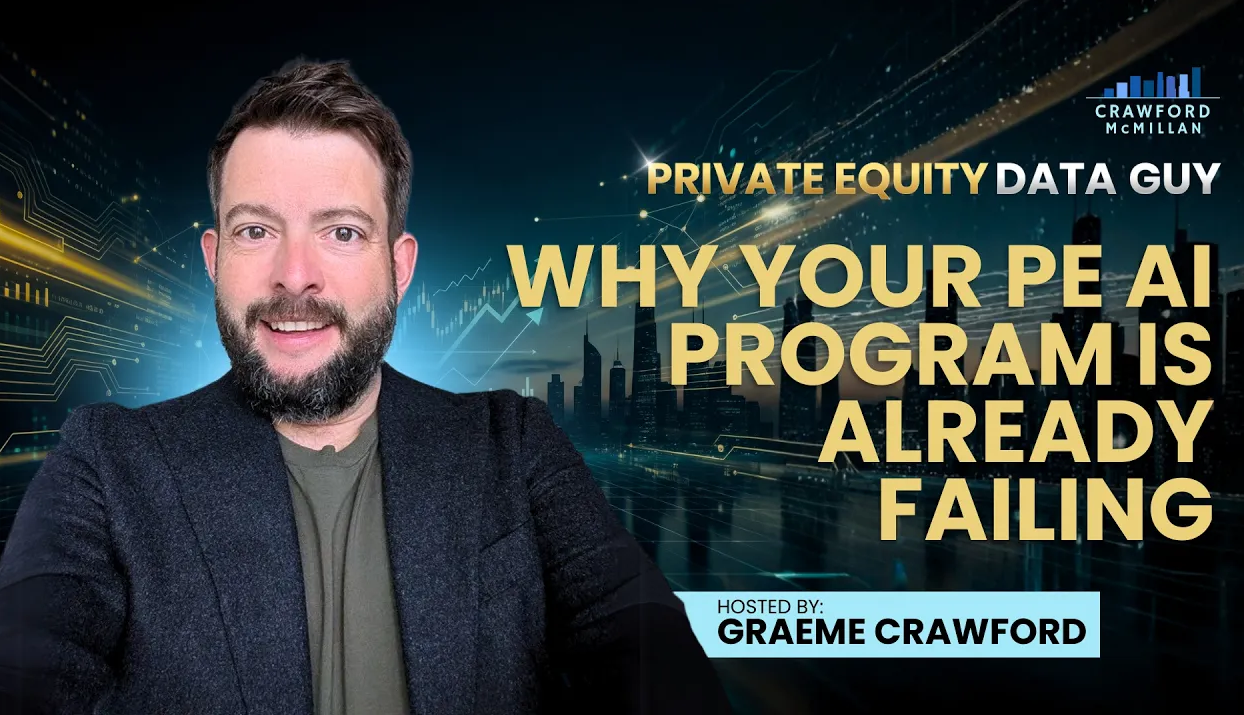
Why are AI projects failing in PE-backed companies?
Shawn Olds has spent two decades deploying AI inside companies and has a number that should bother every operating partner: over 80% of AI programs in portfolio companies fail. Not because the technology breaks, but because nobody in the C-suite owns it. He walks through what McKinsey and MIT both found independently, why CEO-backed programs are the only ones delivering real EBITDA impact, and a security industry example where existing data nobody was using could eliminate $15 million in annual costs without buying a single new tool.
AI keeps getting better for projects 'around the house'
I spent a couple of hours one evening this week building an AI flow with my kids which end-to-end creates YouTube shorts (sources reserach, creates images, builds voiceover, animates, adds captions) on any given topic.
We chose the hyper-relevant topic of things that you don't want to ask your parents about because if you do they'll turn into a life lesson or lecture. Here's the 'Skip The Lecture' channel that we came up with.
The tech just keeps accelerating...
Two News Stories From This Week in Mid-Market PE & Data
CNBC - Private equity enters its 'Darwinian' era
The story: PE firms returned roughly 14% of assets under management back to investors in 2025, the worst distribution rate since the financial crisis. Lucinda Guthrie, head of Mergermarket, points to a growing population of "zombified" assets sitting in fund backlogs with no clear exit path.
Rather than sell at lower valuations, managers are rolling portfolio companies into continuation vehicles to buy time. The result is a shakeout. Smaller, undifferentiated funds are not getting acquired by larger players. They are facing extinction.
What it means for you: Distribution pressure changes the entire conversation between operating partners and portfolio company leadership. When LPs are not getting paid, every asset in the portfolio is scrutinized more closely.
The companies that move to the front of the exit queue will be the ones that can produce defensible numbers on demand, clean data rooms, consistent reporting, and metrics that hold up under diligence.
The ones stuck in the backlog are there for a reason. If your portfolio companies cannot answer basic data questions without a fire drill, that is the problem to solve before the exit window matters.
Bloomberg - Apollo's Sambur Sees Prolonged Period of Software Pain for PE
Source | Feb 20, 2026
The story: David Sambur, co-head of private equity at Apollo, said publicly what most GPs have been thinking quietly: "Only now have people focused on the multi-car pileup that's about to happen on the software investing highway." Software has accounted for roughly 25% of PE deal value over the past five years.
Apollo's response was to avoid the sector entirely, carrying less than 2% exposure across the group. The February selloff wiped over $1.2 trillion in public software market value in five trading sessions, and the repricing is now reaching private portfolios.
What it means for you: Most mid-market PE portfolios have meaningful software exposure, whether through pure-play SaaS companies or portfolio companies that depend heavily on software vendors. The firms that navigate this will be the ones that understand their data assets at a granular level.
Can the portfolio company demonstrate its product stickiness through usage data and switching-cost metrics? Can it show customer concentration, churn trends, and revenue quality with numbers that hold up?
AI is compressing the moats that software companies used to take for granted. What remains defensible is proprietary data, deep workflow integration, and the operational infrastructure to prove both. That is a data readiness problem.
Free Tool of the Week - What Kind of Diligence Prep Leader Are You?
Every leadership team has a default mode when diligence approaches. Yours has strengths and blind spots. This quick quiz surfaces both.
Sign-off
If this resonates and there's something you think we can help with, just reply to this email. We read everything that comes through.
As always, please forward this on to your favorite PE-backed friend.
Cheers,
Graeme