Small number or big number? Depends who's paying for the headline

Like a moth to a flame I flew back into the data center water usage rabbit hole this week. Without dragging you back down there with me, here's a neat 2x2 I made for the key measurements.
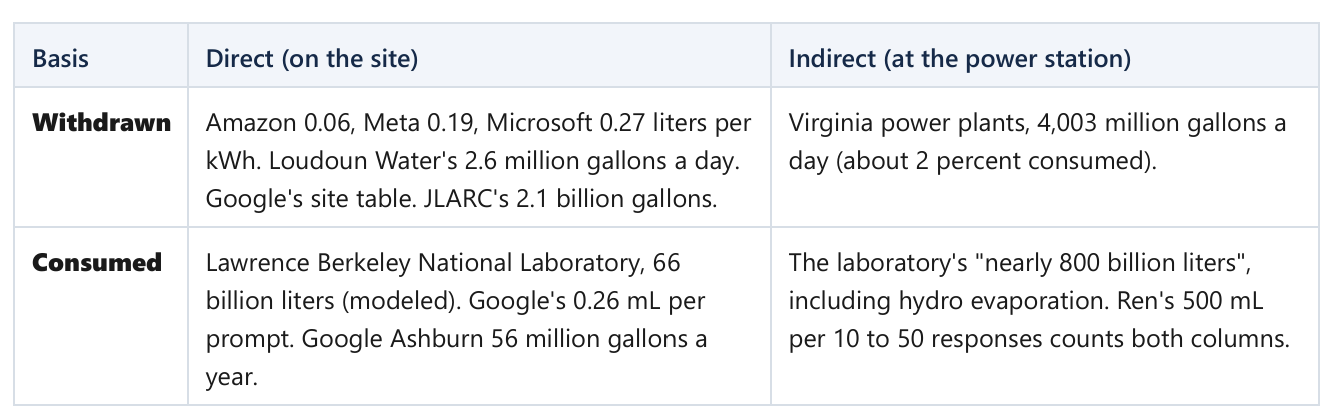
So - in the most simple terms - if you want the number to be small, you use top-left (water withdrawn from the system on-site) and if you want the number to be large, you use bottom-right (all water used including power generation and water recycled back into the system).
Something to watch out for the next time you read some media hype in either direction.
Three other fun events last week:
- I went to a 'local business leaders' lunch hosted by my attorneys at Bean Kinney Korman in Arlington, VA where AI was super high on the agenda (surprise!).
- I was a guest on Justin Dixon's Growth Capital podcast - watch this space for some clips and coverage when my episode airs in 3 weeks.
- I attended a golf day hosted by SS&C intralinks - lots more interesting chatter about how tricky it is to price anything (but particularly software) in this market.
I also listened to the latest from DrK Healthygamer, where he discussed this troubling data:
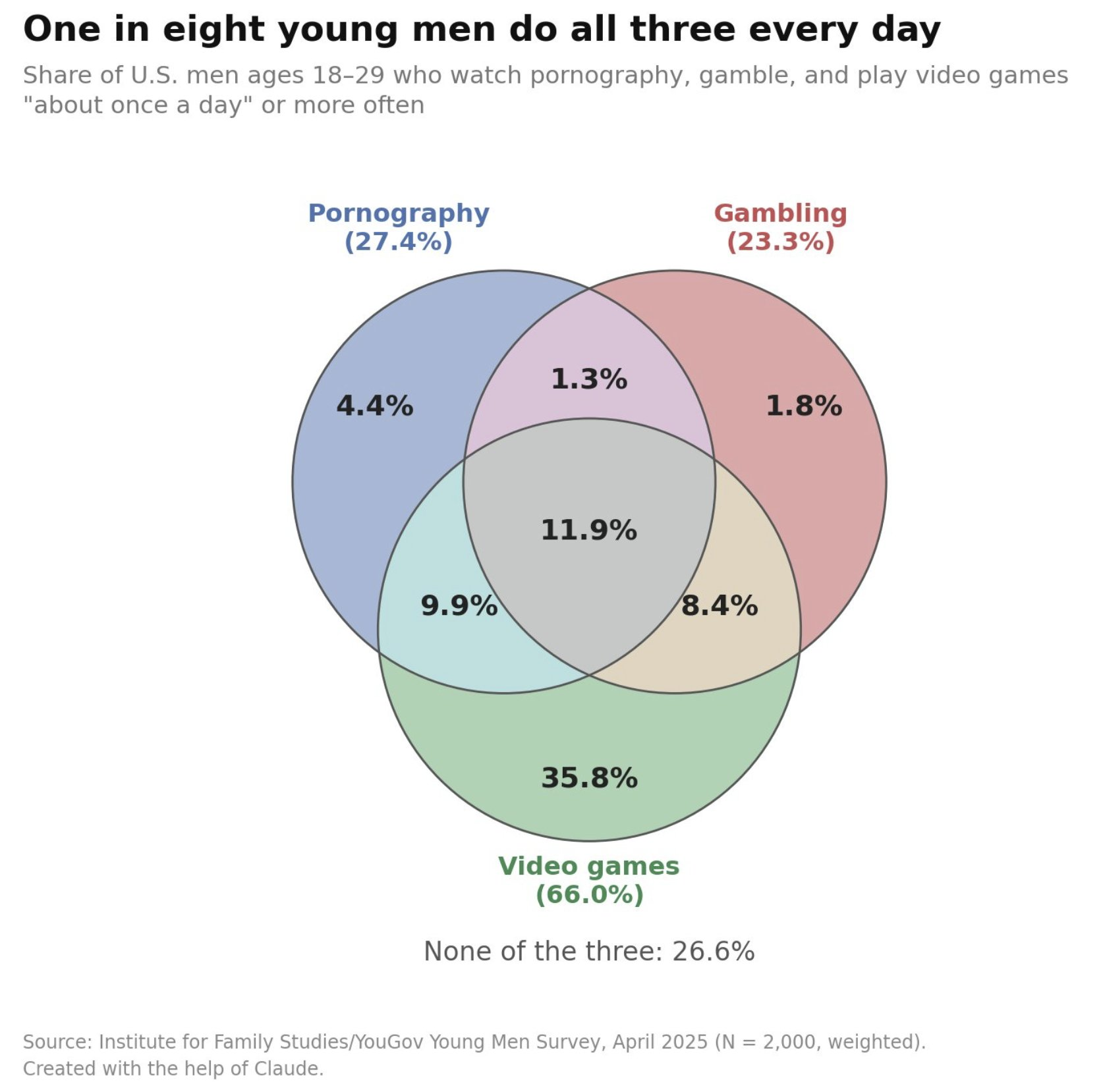
As a parent of 2 young men myself this topic is very much front of mind for me. I appreciated that a lot of the conversation was about the causes (lack of purpose, avoidance of hard things, pressure to succeed) rather than the trappings.
Definitely worth a listen for other boy parents out there.
Enjoy the rest of the memo!
Graeme
Three Things I Learned This Week
Dan Granger interviews your target’s customers inside the LOI window
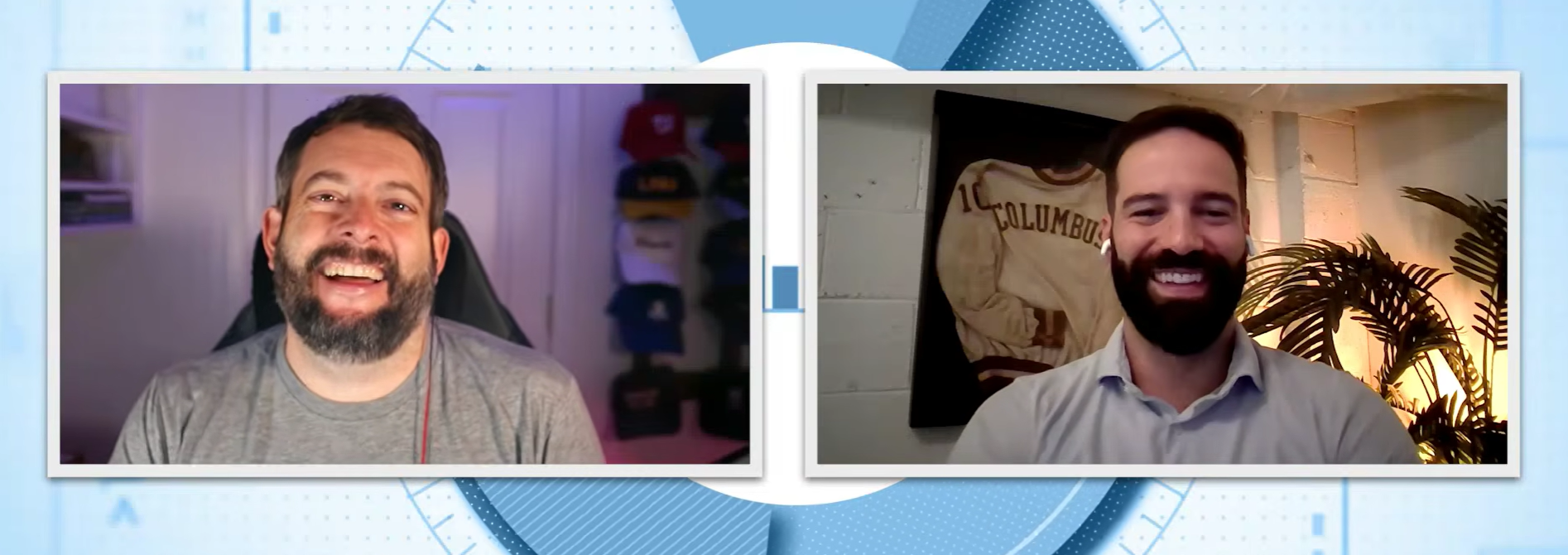
Dan Granger runs the private equity practice at T4, a voice-of-customer research consultancy that backed into PE by accident. He was my guest on PE Data Guy this week.
A PE sponsor asked if T4 could work a live deal in 30 days instead of the usual 8 weeks. That truncated product became a diligence offering that now drives a chunk of the firm’s revenue.
“Customer perception is reality,” Dan told me. “I don’t care what you believe within the four walls of your business. That is not driving purchasing decisions. What’s driving purchasing decisions is the perceptions of your customers.”
One throwaway aside during the episode reads like a translation of every data diligence I have ever run. “I’ve had many customers tell me they’ve got clean data, and we find a slightly different story when we send a team in.”
What management believes about the numbers, and what the numbers say once someone independent asks the question, are two different documents.
The T4 approach pulls the ego out of the room. The deal team stops relying on the target’s account manager to represent the customer relationship, and the sponsor and the operator both get the same unblinded read from a neutral third party. Ground truth becomes shared before the wire clears, which changes how the 100-day plan gets written.
Dan named a limit on the AI that would in theory replace him. “AI still really struggles with the nuance of being able to connect unstructured data. You still need human intelligence to pick up on body language, tonality, pull at different threads and ask probing questions.”
Voice-of-customer work is one of the places where a human on the phone beats a model reading transcripts. It also shows the customer that the sponsor values their time, which by itself is a signal worth buying.
If your diligence process is not asking the target’s customers what they think inside the LOI window, you are relying on the target’s account team to represent them. That is who has the strongest incentive to make the picture look clean.
Watch the full conversation here.
The AI savings you thought you’d capture just walked out the door
Axiom’s 2026 in-house legal AI survey put a hard number on something Lee McCabe framed sharply in Not Very Private Equity last week. 79% of law firms now use AI to improve efficiency. Only 6% pass any saving to their clients. 34% charge a premium for AI-assisted work.
The banks noticed. Goldman Sachs now asks its firms how much AI is saving them and takes those answers into fee negotiations. Morgan Stanley’s GC has publicly called Big Law’s associate-heavy model “extraordinarily unstable.”
Lee’s frame is the useful part for anyone underwriting a professional-services asset right now. “The firms thought they were announcing margin expansion. The banks thought they were being offered a discount. Both cannot collect the same saving.”
Two consecutive NVPE editions have argued a version of this. On September 4 it was the McKinsey State of AI finding that 37% of firms can attribute any EBIT impact to AI, flat year on year.
On September 11 it was the Axiom 79%/6% gap. Same structural point from two different data sets. Adopting AI and capturing its value are different projects, and the capture only happens if the commercial terms of the relationship let you keep the saving when your delivery costs fall.
For any services or software portco, the underwriting case that assumes steady fees plus a small margin lift from AI is the pattern that ends with customers and competitors extracting the saving at every renewal.
Lee’s diligence question checks four things: contract terms, renewal outcomes, competitive bids, and the actual prices achieved as delivery costs fall. Together they tell you who is keeping the saving. Credit Not Very Private Equity for the framing.
90% of GPs would take a haircut on a long-held asset for cash today
The EY Private Equity Pulse this month asked GPs a question that quantifies the pressure the exit queue is putting on managers. 90% said they would accept a discount to their original underwriting for immediate liquidity on a long-held asset. Most commonly the discount they would accept is 6 to 10%.
That figure pairs directly with last week’s JPMorgan Asset Management finding. Companies held under 5 years exit above the GP’s own valuation estimate 87% of the time. Nearly a third of companies held more than 10 years exit below the portfolio mark.
The queue costs price on the way out, and the managers holding the long-held assets know it. Every quarter a company sits past year 5 moves it toward the second group, and the GP willingness to accept a haircut is the market voting on where each company sits. The mark on the books is the ceiling. Every quarter of hold that passes without a real process attempt is a downward vote on that mark.
For an LP running an allocation review this quarter, the useful question is a comparison. Which companies could clear a process at the mark in the next 12 months? Which would the GP already privately discount to get out of? The gap between those two lists is the DPI risk the mark does not capture.
Two News Stories From This Week in Mid-Market PE and Data
Warburg’s 15-year hold on CPP exits at 18x. The buyer is strategic, not sponsor.
Sources: BosotonWarwick.com
What happened. GE Aerospace bought Consolidated Precision Products from Warburg Pincus and Berkshire Partners for $11.75bn, around 18x next year’s earnings including synergies. Warburg paid roughly $459m for CPP in 2011.
On its face this is a textbook long-hold PE story. Buy an industrial platform, compound for 15 years, exit big. The buyer is GE Aerospace, a strategic company. Sponsor-to-sponsor bidding is not what closed this deal.
Why you should care. The 15-year hold on CPP is a strategic buyer underwriting a specific industrial capability. The rest of the queue is sponsor-to-sponsor, and sponsor buyers have been more selective in 2026 than they have been in a decade.
If your exit thesis depends on another PE firm buying at multiple expansion, the CPP outcome is a reminder that the scale exits are being done by strategics who see something in the asset that a sponsor cannot underwrite.
The question for any mid-market portco heading toward a process is which strategic buyer would care about the specific capability the business has built, and whether the data supports that story or gets in the way of telling it.
Tech deal value fell 50% year on year while non-tech deal value rose 9%
Sources: PwC US Deals midyear insights | Cherry Bekaert Mid-Year 2026 US PE Report
What happened. PwC’s midyear US deals data puts a hard number on the sector split. Tech-focused PE deal value fell 50% year on year while non-tech deal value rose 9%. The pattern lines up with the Cherry Bekaert finding that software deal value specifically fell 65.7% year on year to $10.7bn in Q2 2026, down 90.3% from its peak three quarters earlier.
Why you should care. The market is moving in most sectors. It is slow in the one most mid-market sponsors overweighted in 2020 and 2021. Industrials, healthcare services, business services and consumer are all moving.
Software is where buyers are least willing to lean in right now, and the McKinsey build-vs-buy data (32% of organisations chose not to buy a software product because they could build it in-house with coding agents) is compounding on the same side.
If a chunk of your portfolio is SaaS and the exit thesis assumed the 2021 multiple environment, the next 18 months look like a renegotiation of what a defensible software revenue story looks like at exit.
Buyers want proof of usage beyond seat count, hard concentration analysis, evidence that any AI-adjacent capability is a real moat, and a defensible answer to the build-vs-buy question that the McKinsey data just made harder to duck.
Free Tool of the Week - The Diligence Clock
The queue above is now well-documented. What matters for any individual portco is where it actually sits on the readiness curve that separates the companies that clear a process from the ones that keep sitting.
The Diligence Clock maps each portco against the workstreams that should already be in motion for a credible sale in the next 12 to 24 months. One page. Two minutes.
Useful before the next investment committee review of the portfolio’s exit sequence, or before the next conversation with a banker about a company that has been in the portfolio longer than the fund’s original horizon.
Sign-off
If any of this lands and there is something you think we can help with, just reply. We read everything that comes through.
As always, forward this on to your favorite PE-backed friend.
Cheers,
Graeme