Too long to sprint, too short to coast
Hey there!
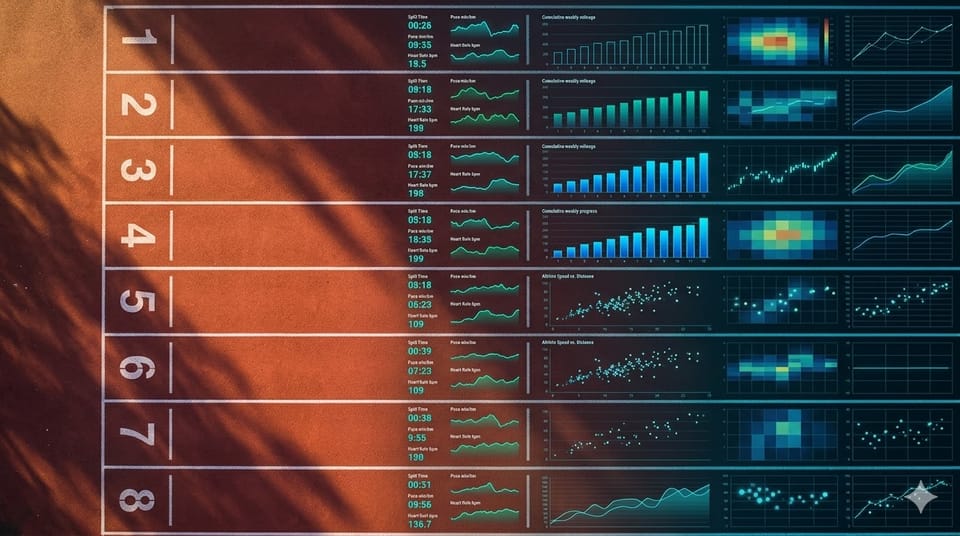
I just finished an eight-week challenge to reduce my one-mile treadmill time. It's a fascinating distance - too long to sprint, too short to coast. A tough challenge.
A little bit like AI in business really. Rush too fast into the newest trend and you're opening up security risks and the chance of the next company's release being ten times better. Wait too long and your competitors start to streak ahead of you.
And in both cases you don't find out for sure if you got it right until afterwards.
I actually used the AI feature on my Whoop band to help guide my last couple of weeks of training as well as plan out the pacing of the challenge for me. Who knows if it helped or hindered but the data certainly gave me more certainty going into it.
Anyway, I'm resting my legs for a few days. Enjoy the rest of the memo!
Cheers,
Graeme
Three Things I Learned This Week
39% of GPs have already given up on AI making a difference this year
Bain and StepStone surveyed 103 GPs for their 2026 outlook. The headline that caught me: 39% do not expect AI to have any material financial impact on portfolio companies this year. A few even expect investment drag. Meanwhile, the GPs who are seeing returns from AI report them overwhelmingly in due diligence and deal sourcing, not in portfolio operations.
The pattern (again, for those in the back not listening) - AI works where the data is already structured (deal documents, market data, financial filings). It stalls where data is fragmented, ungoverned, and spread across three ERPs from two acquisitions ago. The 39% have not given up on AI. They have discovered they have a data problem they were not expecting to have to solve first.
Sandwich Shops and Large PortCos have the same data issues
Something different this week, a solo episode featuring just yours truly. I walk through a mini data maturity assessment I did for a friend who runs a sandwich shop in my local town.
It's intriguing how the same problems show up at many different scales of business. Check it out and let me know what you think.

A lack of confidence killed more dreams than a lack of competence ever did. (from Chris Williamson)
This was on my mind during the treadmill mile:
"More people are held back by their self-belief than propelled by it.
You can think about confidence as a speed limiter on your system.
You have capacity for more but your self-doubt limits your ability to chase it.
Self-doubt causes you to avoid taking risks which means you move more slowly than your competition.
It encourages you to criticise your performance, even when you do well, which damages your motivation.
It makes you compare yourself to other’s achievements, making you feel inferior by comparison.
Your mind is not helping you here.
Placing insatiable demands on your performance doesn’t drive you to perform better, it just makes you sad at never feeling satisfied, even with a job well done."
Two News Stories From This Week in Mid-Market PE & Data
Story 1: OpenAI in talks with four PE firms to build a $10B enterprise AI deployment arm
Source: Axios | PE Insights
What happened. OpenAI is in advanced discussions with TPG, Advent International, Bain Capital, and Brookfield to create a majority-owned subsidiary focused on deploying AI into enterprises. The structure being discussed values the subsidiary at approximately $10 billion pre-money, with the four PE firms investing roughly $4 billion collectively for equity stakes, board seats, and preferred returns. The subsidiary would employ its own engineers to build, advise on, and directly deploy OpenAI's tools into portfolio companies and other large enterprises. This runs alongside OpenAI's separate Frontier Alliance, which includes consulting firms like McKinsey, BCG, and Accenture.
Why you should care. Last week it was Anthropic talking to Blackstone and Hellman & Friedman. This week it is OpenAI talking to TPG, Advent, Bain Capital, and Brookfield. Both of the world's leading AI companies have arrived at the same conclusion in the same month: enterprise AI does not sell itself. It requires a dedicated deployment and integration layer, and they are going to PE firms to build it.
Four billion dollars in PE capital is not flowing into this subsidiary because portfolio companies are ready for AI. It is flowing in because they are not, and that gap is large enough to justify a standalone business. If the biggest AI companies on the planet need consulting arms to make their own products work inside your portfolio companies, the bottleneck is not the AI. It is the data, the systems, and the readiness underneath.
Story 2: PE-backed wealth managers closed 15 acquisitions worth $28 billion in two weeks
Source: Markets Group
What happened. In the first two weeks of March, PE-backed acquirers closed 15 RIA (registered investment advisor) acquisitions, representing over $28 billion in client assets. Every single deal involved a PE-backed or externally owned buyer.
The two largest: NewEdge Advisors acquired Stonegate Investment Group ($6 billion AUM, 13 advisors) and Hightower Advisors acquired Journey Strategic Wealth ($5 billion AUM, 24-person team). PE firms now drive 69% of RIA deal activity in 2026, up from already record levels in 2025, when 466 deals closed.
Why you should care. Fifteen acquisitions in two weeks. Each one brings a different client database, reporting platform, custodial integration, and performance calculation. This is the add-on acquisition data problem at an industrial scale. Wealth management is one of the most data-intensive verticals in PE, and the roll-up playbook only works if you can integrate client records, compliance reporting, and portfolio analytics across every acquisition without losing data integrity or regulatory standing.
When you are moving this fast, the firms that have a data integration playbook ready on day one will compound value. Those who figure it out later will spend 18 months reconciling spreadsheets while the next deal closes on top of the last.
Free Tool of the Week - Data Room Survivor
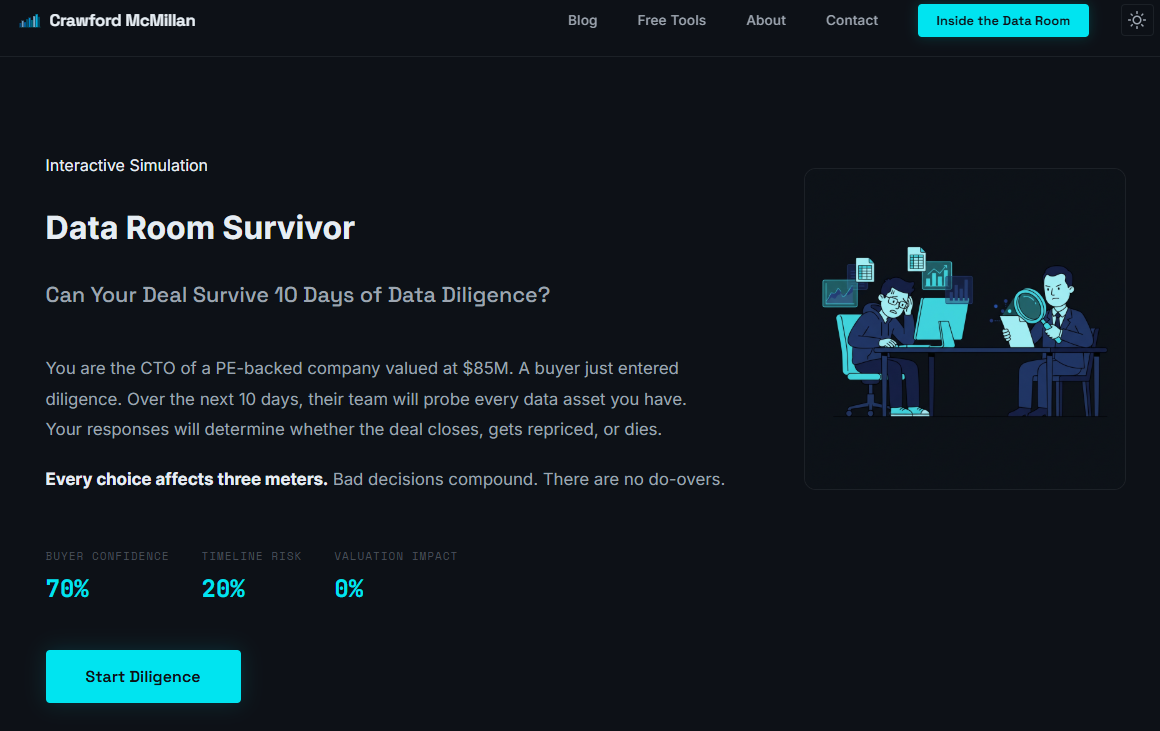
A few readers played Data Room Survivor after last week's newsletter and sent me their scores. Nobody survived with their valuation intact. If you missed it, the game puts you in the CTO seat during a live diligence process. Ten days, ten decisions, real scenarios. Five minutes. See if you can beat the crowd.
Sign-off
If this resonates and there's something you think we can help with, just reply to this email. We read everything that comes through.
As always, please forward this on to your favorite PE-backed friend.
Cheers,
Graeme