Five questions that make a board pause
Hey there,
I’ve been trying to make the most of time with the kids before they head back to school next week.
I took my 14-year-old go-karting on Sunday, where the data showed that my 30+ years of driving beats out his higher top speed due to a lower payload. The data did also show, however, that he beat me at the arcade punching machine - he’s over a year into boxing training now and it’s really paying off for him (albeit at the cost of my ego)!
My AI adventures also continue - I spent the weekend spinning up my virtual agent team, naming them, giving them objectives (which often disagree) and setting up weekly reviews to track their success.
The company knowledge graph I’ve spent all this year building out is the critical foundation that may just make this transformative. Excited to share more on that next week after a week of positive ideological conflict the first round of performance reviews!
Last week I promised to tell you how my session with Kit Lisle’s operator community went. Well it was excellent!
Twenty-odd operating partners and advisors spent an hour interrogating a fictional CFO (me) about a board pack where every number was green, and they went at it harder than I expected.
The whole debrief is the first item below, including the five questions the room ended up with. They work on a real board pack exactly as they worked on the made-up one.
There is also a new PE Data Guy episode this week with Philip Curran, whose book The Hidden Emotional Contract came out yesterday. Philip and I co-wrote a piece earlier this year on the two blind spots that kill value in portfolio companies, data integrity and leadership integrity.
Enjoy the rest of the memo.
Cheers,
Graeme
Three Things I Learned This Week
What a room of operators found in an all-green board pack.
On Thursday I showed TheOperators community a board dashboard from a fictional portfolio company called Copperline Industrial Supply. A specialty distributor, roughly $85M of revenue, seven branches, one add-on still running its own ERP.
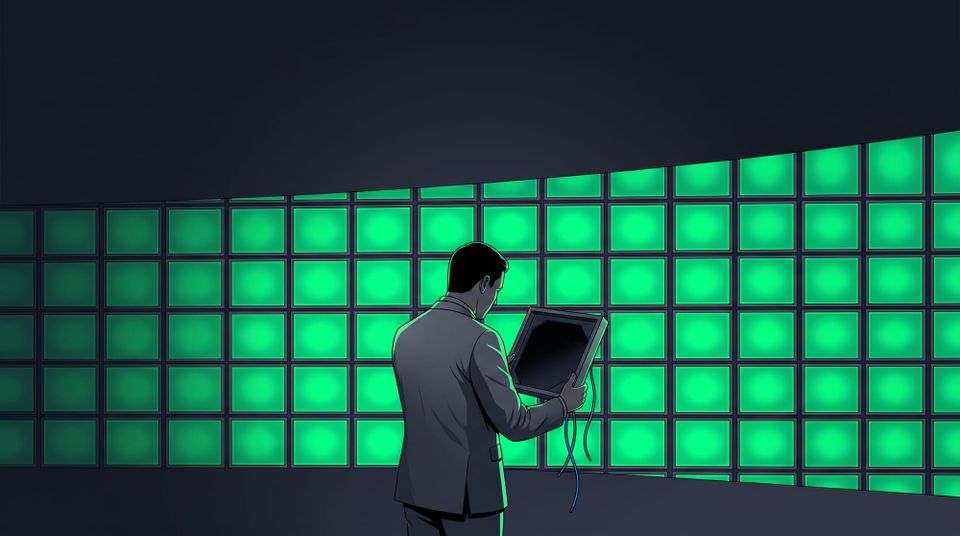
Every KPI on the pack was green. Revenue ahead of plan, margin above target, rebates on plan, concentration under the watch line, every branch performing, six reporting packs delivered on time. The company was also quietly missing its value creation plan, and the room’s job was to find out why. I played the CFO. The rule was that I would answer every question truthfully, but only from what Copperline’s systems could produce. Nobody in the game was lying. The data was.
The room’s first move says everything about how experienced operators read a board pack. The very first challenge was aimed at what was missing. Where is the cash flow number, and how do I know this company is not in the tank? A distressed-operations leader asked it inside the first minute, and it is the right first question every time, because a dashboard is defined as much by what it leaves out as by what it shows.
From there the interrogation went straight at two of the most trusted-looking tiles, on-time-in-full and revenue, and here is the twist. Both survived. The room spent its early energy accusing the two honest numbers on the pack. Green that stands up to interrogation buys credibility for everything around it, and that is exactly how the deceptive tiles hide.
The best contribution of the session came off the back of a reveal. When on-time-in-full turned out to be honest, one member pushed past accuracy to a better question. The number is real, but it is average, not best in class, so maybe the growth you are missing is hiding in a green tile that is telling the truth.
A dashboard can be perfectly accurate and still conceal the plan miss, because “on target” and “good enough to hit the thesis” are different standards, and only one of them was ever wired into the KPI.
Five questions for you to take away from Copperline for your next board pack.
- Which of our KPIs would change if we recomputed them from source rather than the reporting layer?
- Do our systems agree on who our customers are, and which answer does the board pack use?
- What level of granularity is the value creation plan priced at, and can the business report at that level?
- Can anyone show where each number on the pack came from without opening a spreadsheet?
- Which green numbers are produced by a person rather than a process, and what happens when that person leaves?
Ask them at your next board meeting and watch which ones produce a pause. The pause is the finding. My thanks to Kit for the invitation and to the community for playing the game harder than I expected. If you run an operating partner group or a fund offsite and want the game run live, reply to this email. It travels well, WiFi permitting.
Culture is not HR’s job, and neither is your data problem
Philip Curran has spent four decades inside leadership teams that either hold together or quietly come apart. He runs Rinnovare HR, an interim CHRO and human capital advisory practice for CEOs and PE operators, and built the RQ diagnostic, which measures a leadership team’s reliability at enterprise level and puts a cost on misalignment.
His first book, The Hidden Emotional Contract, published yesterday. Its spine is eight promises leaders make without knowing it. Dignity, clarity, safety, meaning, growth, recognition, belonging, agency. Break them and people withdraw, protect themselves, stop taking risk, stop collaborating, long before the numbers show it.
I offered Philip my definition of culture (what gets rewarded and what gets punished, summed across every leader) and he gave it a solid C. His is shorter. Culture is the lived experience of people working for you, and it is driven by the exhibited behaviors of leaders. HR cannot create it. Leaders create it every day, in every meeting and in every moment of silence. The only choice is whether they do it by accident or on purpose. He put it another way that I have been repeating since. Culture is the hidden emotional contract at scale.
Where this collides with my world is the five-definitions problem. In the piece we co-wrote, five executives in one portfolio company gave five different definitions of a customer, and diligence surfaced three revenue numbers as a result. Philip’s point on the recording is that the cost lands well below the boardroom. Every manager downstream has to compensate on the fly for the fact that their leaders never agreed on what a customer is, which means slower work, slower decisions, operational workarounds, and reporting nobody trusts.
My addition is what happens on the way back up. A department measured on customer count picks the definition that makes the number biggest, and what arrives at the board is a green tile that should not be green. I asked him which comes first, the fractured data or the fractured leadership, and he would not pick. Either one can be the origin. Both are always present.
The part I keep coming back to is his answer on why PE in particular breeds the hero, the person I call the one-person spreadsheet and Philip calls a symptom of speed as the singular driver. Do something, and if it is wrong, fix it on the fly. It rewards the executive convinced of their own immortality, and Philip was candid that he used to be that executive until, thirty years ago, he stopped liking the man in the shaving mirror.
Decision velocity always matters in a PE company, he said, and then described how it dies. A decision falls into the gap between two leaders’ remits, or worse into the overlap, and gets relitigated in the meeting after the meeting, on the elevator. If you have ever walked into a portfolio company and felt something was off before you saw a single number, this episode names the feeling. Watch the full conversation here.
“We have turned a clean dataset into USD 10 million EBITDA uplift”
That is Wolf Scheider, head of private equity at Partners Group, in a press release on August 3, and I have not seen a sponsor say the sequence out loud that plainly before. Foundation Risk Partners, a fast-growing US insurance broker in the Partners Group portfolio, built a clean, proprietary policy-level dataset first.
Then Version 1, another Partners Group portfolio company that does AI-first digital transformation, built two agentic AI tools on top of it. One cut the policy processing cycle for new clients by 94 percent, which doubled close rates. The other automated the manual policy-checking task. Partners Group puts the result at 120 basis points of EBITDA margin and USD 10 million of financial impact, delivered by a seven-person team with the first use case in production in 14 weeks.
Read the order of operations again. Dataset first, agents second, EBITDA at the end. The AI part of the story ran for 14 weeks. The dataset is the part nobody put in the headline and the part without which there is no headline.
Every operating partner reading this has a portfolio company with the FRP problem, meaning proprietary operating data sitting in a system that cannot yet produce a clean, well-governed version of it. That is the prerequisite for the 120 basis points, and it is buildable inside a quarter. The agents are the easy bit now.
Source: Partners Group press release, Aug 3, 2026, via Benzinga
Two News Stories From This Week in Mid-Market PE and Data
A quarter of executives say AI errors have already reached their board or their investors
Source: Workiva 2026 Midyear Executive Benchmark Survey, via Thomson Reuters, Aug 11
What happened. Workiva surveyed 2,272 finance, risk, sustainability, and legal professionals plus 367 institutional investors in May. One in four executives said errors generated by AI tools had made their way to boards or external audiences. Only 11 percent said their organization’s data quality was sufficient for AI use, and 71 percent said poor data quality had at least moderately held back their use of AI in financial reporting. Meanwhile 84 percent were at least somewhat confident in AI-generated material appearing in an annual report without human review. On the other side of the table, 89 percent of investors said they were concerned about AI accuracy in company filings and nearly half said they actively hunt for signs of AI-generated errors in the documents they read.
Why you should care. Put the 11 percent next to the 84 percent and you have the whole problem in two numbers. Almost nobody thinks their data is good enough for AI, and almost everybody trusts what the AI produces from it. That gap is now landing in board packs and investor materials, and half the people receiving those materials are reading them looking for the mistake. If you back or run a mid-market company, this is the Copperline story with a machine in the loop. A green tile produced by a person you can at least ask about. A green tile produced by an AI agent from an ungoverned dataset will be confidently wrong, and the buyer’s team is being trained to find it. Workiva’s own advice to its clients is the same advice I give. Standardized definitions, one source of truth, documented lineage, and then AI. Not the other way round.
European sponsors have put AI in the investment thesis and operational diligence in the process
Source: Alvarez & Marsal, European Due Diligence Report 2026, Aug 11
What happened. A&M surveyed more than 80 senior PE professionals across Europe for its first due diligence report. Eighty percent of sponsors now incorporate AI into the investment thesis as a driver of operational or commercial value, split between those who see it as an efficiency lever (41 percent) and those who see it as a growth enabler (39 percent). Value creation is still the headline objective of diligence at 93 percent, but around 60 percent say the exercise is now equally about value protection and downside risk.
Sponsors say they want operational assessment with the same rigor as commercial and financial work, covering cost structures, workforce capability, technology readiness, and leadership capacity to execute. And only 18 percent say advisors actually offer a fully integrated diligence product.
Why you should care. Three findings that look separate are one finding. If 80 percent of buyers are underwriting AI as a value driver, then whether the target’s data can support AI is now a diligence question, whether or not the request list calls it that. If diligence has swung toward downside protection, the softest thing in most mid-market data rooms, the reporting layer, is what gets pushed on.
If buyers want operational and technology readiness assessed alongside the numbers and cannot buy that integrated, they will build it themselves, one awkward management-meeting question at a time. Sellers who have already answered those questions, with evidence, walk into a process where the buyer is prepared to pay for what they can prove. Everyone else is on the wrong side of the 60 percent.
Free Tool of the Week - The VCP Data Score
The Directory held this slot for three weeks and only gives it up because Copperline earned it. Question three of the five above, whether the value creation plan is priced at a level the business can actually report at, is the one that produced the longest pause on Thursday. The VCP Data Score is the two-minute version of that question. It scores a portfolio company’s data readiness across the five dimensions a value creation plan depends on, from revenue data through to governance, and gives you one page to bring to the next operating partner review. Run it on the company whose board pack is greenest.
Sign-off
If any of this lands and there is something you think we can help with, just reply. We read everything that comes through.
As always, forward this on to your favorite PE-backed friend.
Cheers,
Graeme