
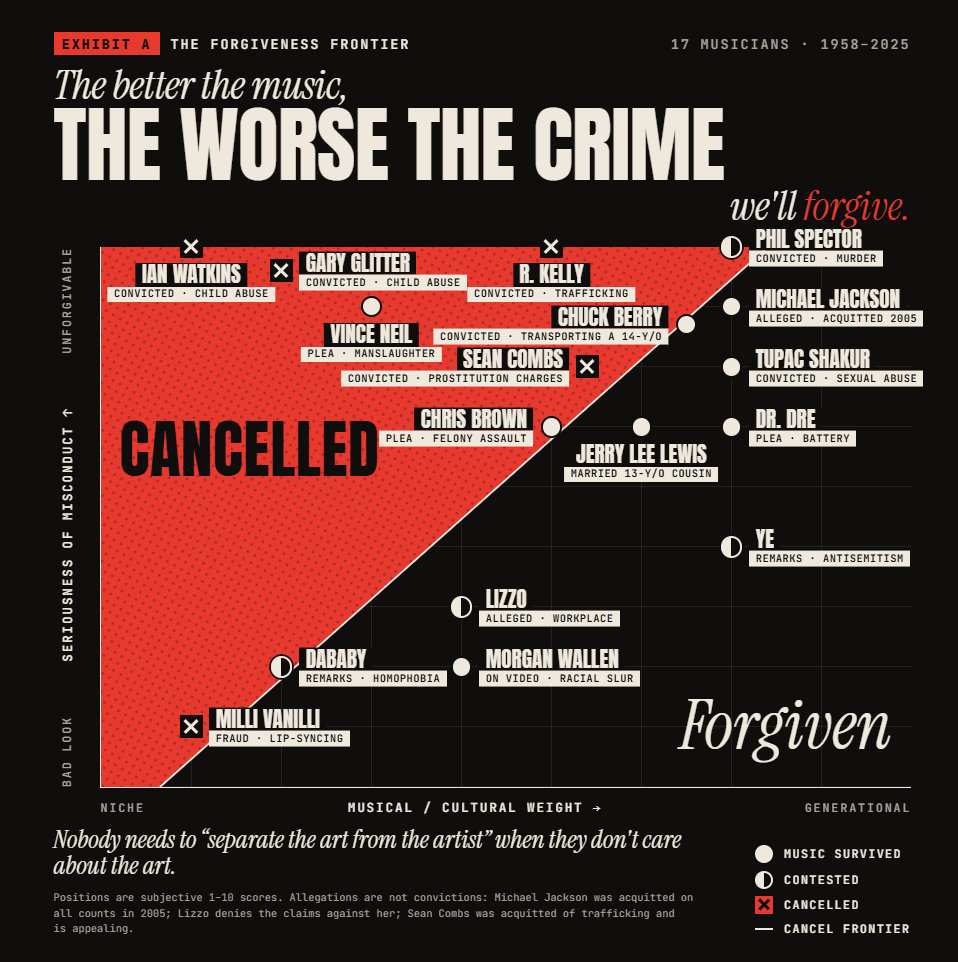
The better the music, the worse the crime we'll forgive.

You may have noticed a blip in the weekly cadence last week, unfortunately my father passed away and I was back in Scotland at short notice.
I want to shout-out to both my clients and my team, who were all incredibly understanding and supportive while I took care of my family and myself.
For what it’s worth, I don’t think my dad ever approved of me starting a business and thus ‘not having a proper job’ - but he did know that I loved doing it and I’m sure he’d be keen for me to jump back into it ASAP. So let’s do it.
In some of the travel downtime I had, I conceived a 2x2 matrix around a hypothesis I’d long carried about the quality of a music artist’s work affecting what crimes they can ‘get away with’ in terms of public perception.
Not only was it a fun data exercise, it gave me a chance to test out the latest one-shot capabilities of Claude Design - “give me an eye-catching and unique presentation style”. Results below - let me know what you think of the design and if you’d add or change anyone in here!
This week’s featured PE Data Guy episode is with Rich Kershaw of Leckie Kershaw and it’s a great one. I particularly loved his insights on org charts - you’d think them to be a pretty reliable source of truth and yet…they often tell you very little about how a company actually runs. Much more on that below.
Enjoy the rest of the memo!
Three Things I Learned This Week
Rich Kershaw starts technology diligence with the org chart
Rich Kershaw has run technology and product due diligence on more than 250 companies through his firm, Leckie Kershaw, for investors like Octopus and Maven. When he came on PE Data Guy, I asked him how often technology is the problem.
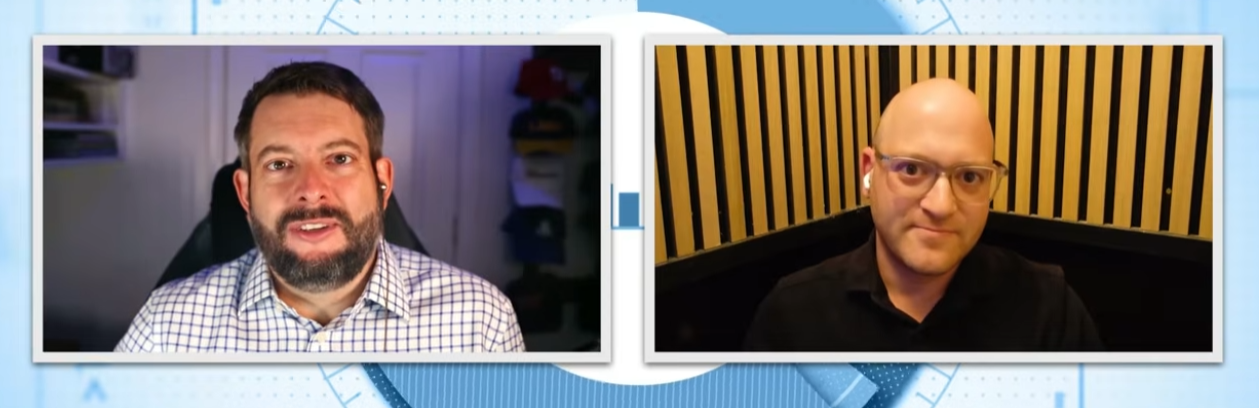
“Rarely,” he said, and admitted that was a dangerous answer for someone his clients know as a tech diligence provider. He can count on one hand the reports that told an investor everything needed to be rewritten.
So he starts somewhere else. He asks for the org chart, and he told me a missing one is as useful to him as a detailed one. “If you’ve got a 30 person company and they don’t have an up-to-date org chart, then that’s usually indicative of vague and ambiguous decision-making in the company. And fundamentally, that’s a people problem. That’s not a tech problem.”
He gave me one case. Investors called him into a well-regarded company of about 60 people, most of them on product. It had not shipped a single new feature in three to six months. The org chart existed. Fifteen minutes into talking to the mid-level, it was clear the chart had nothing to do with how the place ran.
Everybody got on and nobody had a boundary. Each project had a long list of people who were accountable for it, so each of them went to every standup, and most of the company spent four or five hours every morning in meetings. The diagnosis took about 40 minutes of conversation. Rich’s point was that he would never have found it by asking about the codebase.
I see the same thing in data. When a client tells me accountability for a table is shared, I know nobody is doing it. If it is more than one person, it is nobody.
I also asked him why private equity won’t buy diligence in a box. He described a language model as “the enthusiastic, smart, but deeply inexperienced and slightly hapless intern sitting in the corner of the office.” It will read 3,000 documents and tell you what is in them. Sitting with a delivery team for eight hours and working out who really decides is still a person’s job.
One thing to try on your next portfolio company visit. Ask for the org chart. Then ask someone two levels down whether it is true.
Watch the full conversation here.
Your AI pilots aren’t failing. They don’t belong to anyone.
Rich found a product feature that nobody owned. Accordion found the same thing in AI budgets.
A few weeks ago I listened to a full episode of ParkerGale’s Private Equity FunCast in the car, and I’d recommend it to every portfolio company CFO heading into budget season. Devin Mathews had Justin D’Onofrio of Accordion on to talk about how to build a 2027 AI budget.
Devin opened with his own board meeting from the day before. The CTO listed the AI work under way. The board asked what it would cost and how anyone would know it was working. Half an hour later nobody had an answer.
Accordion’s survey puts numbers on that room. 91% of PE-backed CFOs can’t size their AI budget. 83% of portfolios have one or more AI pilots running, and 18% of those are tied to measurable value. 65% of sponsors say the data infrastructure or the data ownership underneath is missing.
Justin’s explanation is the line I wrote down. “It’s not that the pilots are failing, it’s just that they don’t really belong to anyone.” His fix is plain finance discipline. Every initiative gets a named owner inside the business and gets tagged to the EBITDA lever it’s meant to move.
Every experiment gets what he called a leash and a clock. At 90 days you “kill it, fund it, or scale it.” And the data foundation gets funded as its own line, ahead of the tool that depends on it. Devin’s reaction to that one was “that is super hard,” followed by a description of a file server holding version one, version 1.1, final, and the real final, with a model that can’t tell which to read.
Devin also gave owners the other half of the job. The person with the information should have the authority to call timeout, because an owner who wants to please a CEO who is sold on AI will not volunteer that it isn’t working.
I spend my days on the data side of this and the finance side has arrived at the same place. We evaluate AI and data use cases one at a time, each with a named owner and its own return case, and the list that survives is always shorter than the list that started.
If you’re building the 2027 budget now, do the sort Accordion suggests. Put every AI dollar in one of two columns, tied to a lever with a target, or not. Then look at how much sits in the second column.
Listen to the episode here. The companion report is on Accordion’s site.
Name the owner and the odds change
Open Future Forum published a September synthesis of its executive AI surveys, written up as diligence questions for private equity. It puts a number on what Rich and Justin both described.
Where investors could name the person who owns AI in a portfolio company, 9% said they saw nothing measurable from it. Where they couldn’t name an owner, 41% saw nothing measurable.
The seats disagree with each other too. 70% of respondents in the CEO seat expect measurable AI payback inside six months. 42% of respondents in the finance seat agree. Ask who owns AI purchasing and every seat names itself. 2% of CEOs say nobody owns it. 30% of CTOs say nobody owns it, and the CTO is describing the implementation.
A caution, because the report is honest about it and I should be too. It is a synthesis of surveys with modest bases, 118 and 49 on the owner finding, and only 4 of its 245 investor respondents are identifiable as private equity. Treat the direction as the finding. In my experience the direction is right. The deck carries the CEO’s payback date, and a buyer will price the CFO’s.
Two News Stories From This Week in Mid-Market PE and Data
The premium for being a better business has shrunk to 5%
Sources: ACG Insights, Oct 1 | GF Data first-half 2026 figures as presented on ACG’s mid-year webinar
What happened. GF Data counted 170 completed private equity-backed deals in the first half, on pace for about 340 this year and roughly 10% ahead of 2025. The average price was 7.1x trailing adjusted EBITDA, almost unchanged for three years. Underneath that, the premium buyers pay for above-average financial performers has averaged about 15% historically.
It was 7% in the first quarter and 5% for the half. Top performers sold at 7.1x and everyone else at 6.8x. Bob Dunn, who ran GF Data and is now at ACG, put part of the squeeze down to deal mix, since add-ons were 36% of deals and competition for them lifted prices for ordinary businesses.
Why you should care. A third of a turn is not much reward for being the better company. If the multiple won’t separate you from the pack, the return has to come from growth inside the business, and GF Data’s own figures show revenue growth eroding across the companies it tracks.
Scott Linch of Forvis Mazars said on the webinar, “Inorganic growth is only going to take you so far from a valuation standpoint.” That describes the company I keep meeting two years into a hold. Every KPI on the value creation plan is green, enterprise value is exactly where it started, and the leadership team can’t explain why. This data says the exit multiple will not fix that.
The SEC told funds that late numbers are no excuse
Sources: SEC staff statement, Sep 28 | Cleary Gottlieb summary, Sep 30
What happened. The SEC’s Chief Accountant and its Director of Investment Management issued a joint statement on how private assets get valued, with private credit as the focus. Private credit held inside registered funds has grown from $170bn to $270bn in five years. The statement is a set of reminders about existing rules.
One of them reads, “A lack of timely information does not relieve management of its responsibility to estimate fair value.” It goes on to say managers should consider whether the reporting terms in a loan, and how often the information arrives, are enough to support the valuation. Cleary Gottlieb’s read is that this is likely to show up in examinations and enforcement.
Why you should care. That information comes from the borrower, and the borrower is a portfolio company. If your lender is a private credit fund or a BDC, the regulator has now said in writing that its valuation rests on what you send and when you send it. Expect the reporting package to get longer and the deadline to get shorter at the next amendment.
A company that needs three weeks to close a month has just become its lender’s problem as well as its own. The fix is the same one a buyer would ask for, numbers that arrive on time and can be traced to source.
Free Tool of the Week - AI Readiness Assessment
Everything above comes back to one question, whether the company is ready for the AI money it is about to budget. The AI Readiness Assessment is seven questions on the data underneath. One of them asks whether a named individual owns data quality and has the authority to enforce it. Two minutes. Instant result. Useful before the 2027 budget draft goes to the sponsor.
Sign-off
If any of this lands and there is something you think we can help with, just reply. We read everything that comes through.
As always, forward this on to your favorite PE-backed friend.
Cheers,
Graeme