
A $500K token bill, from one user, in one month

Hello there!
This past weekend was frankly apocalyptic in Northern Virginia with the unbearable temperatures and the smoke-filled sky. Lots of indoor time was well-timed around a World Cup final and a major golf tournament on the television at least.
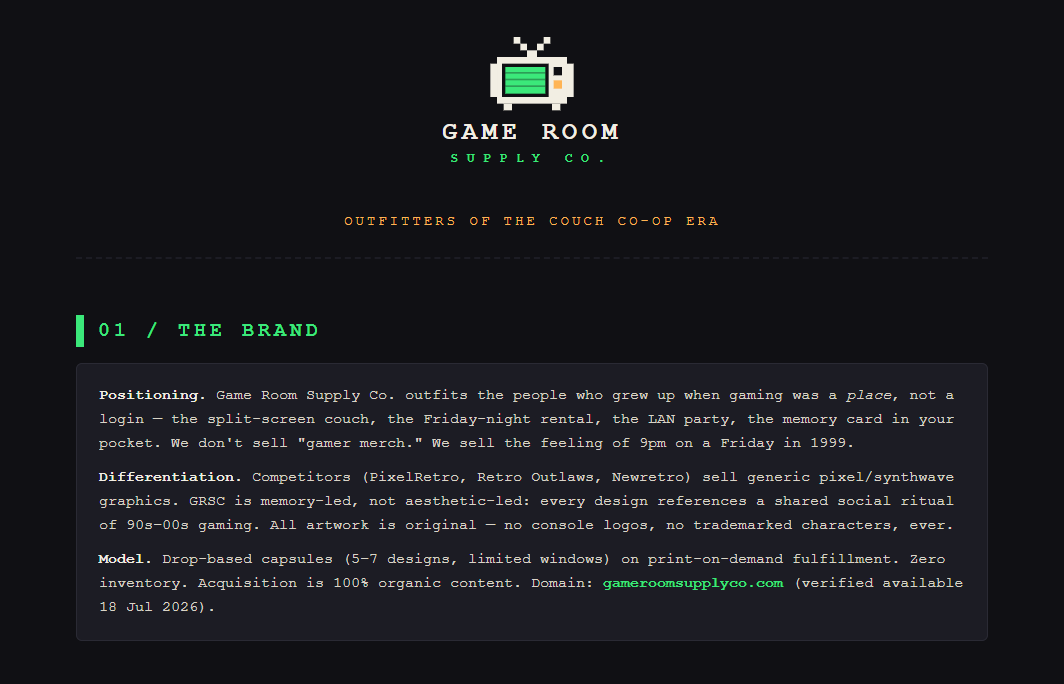
It also gave me a chance to have what I thought was a last tango with Claude Fable. As a test case I set it up to research, set up, create collateral, marketing plans, branding, launch copy, and select product lines for an e-commerce brand based on extensive market research.
It picked a retro gaming niche, aimed to ride the 'gameroom' wave it predicts with the impending release of GTA6 - the biggest video game release in years. Take a look and let me know what you think...or go build it - one business is plenty to keep me busy. 😄
This week’s PE Data Guy guest goes back further than the podcast itself. Brandon Micci and I were partners at Capital One a decade ago, rolling out analytics tooling to 30,000 people. He went on to Citigroup, Southwest, and JPMorgan Chase, where he put an AI assistant in front of 27,000 users in the payments organization.
Which means he has now watched the same movie twice, once with dashboards, once with AI, and he knows exactly which scenes repeat. More from Brandon below.
Enjoy the rest of the memo!
Cheers,
Graeme
Three Things I Learned This Week
You have seen this AI rollout before. It was called Tableau. And Alteryx. And it got expensive.
Brandon and I lived the first version together. Capital One’s CEO evangelized the tooling, 30,000 people downloaded Tableau, and there was no framework underneath it. No training standard, no best practices, no cost control, no plan for replacing the legacy BI it was meant to retire.
At another firm Brandon watched Alteryx hand out trial licenses until 10,000 people were using a $5,000-per-seat tool for basic data prep that a day of SQL training would have covered. Then the trial period ended and the vendor came back with the real price. His words on the episode: “these guys are drug dealers, and I don’t fault them for it.”
Now replace the tool names with Copilot or Gemini. Same movie, bigger numbers. Companies are switching AI on for every employee with generic encouragement from the top and no guardrails, and the bills are arriving: Brandon mentioned single users burning $500,000 in tokens in a month. Some companies now track token consumption as a success metric, which rewards exactly the wrong behavior.
The fix was boring in 2015 and it is boring now. Small pilot group. Training that says here is what it is good at, here is what it is not. Cost controls before scale, not after the renegotiation. The companies that skip this are not early adopters. They are the trial period. Watch the conversation here.
JPMorgan’s first AI use case was deliberately dull. That was the whole strategy.
The first generative AI use case Brandon’s team shipped was about as unglamorous as it gets: answering questions about policies and procedures. No customer data, no PII, minimal risk. It still took a year to clear governance and compliance, partly because the people running the reviews were learning what a hallucination was at the same time as everyone else.
Here is the part worth stealing. That year was not overhead, it was the product. The framework built to get the boring use case through meant the next ones cleared in one to two months, and the program scaled to roughly 30 use cases in production. The first use case’s real deliverable was the approval muscle, not the ROI.
Mid-market companies do not have JPMorgan’s compliance department, but they have the same failure mode in miniature: the first AI project gets picked for excitement, dies in someone’s risk review or in the CFO’s credibility review, and poisons the appetite for everything after it. Pick the first one boring, safe, and useful on purpose. Speed is what you buy with it.
The use-case backlog is the new shelfware
Brandon described something I now see everywhere. Leadership asks AI where the company could use AI, gets a list of 100 ideas back, and the organization proudly maintains a backlog while shipping nothing. Two years ago the metric that got reported upward was how many use cases you had. Now the spend is real, the question has become “where is the ROI,” and it turns out a backlog does not produce any.
The sharpest version of the failure: companies that announced workforce reductions for AI before AI had achieved anything, and are now quietly rehiring the same capability at a higher price. Brandon’s counter-practice at JPMorgan was process mining: baseline roughly 5,000 processes, find where the manual touch points and time sinks actually are, and size the minutes saved into dollars before anything gets built. ROI estimated up front, or it does not enter the queue.
For a portfolio company with a $500K technology budget, that discipline is not optional, because there is no room to fund the R&D burn. The good news from the episode: the quickest provable wins are rarely glamorous. Document intake, transaction processing, the back-office spreadsheet work nobody’s proud of. Start where the baseline is measurable and the win is provable in a quarter.
Two News Stories From This Week in Mid-Market PE and Data
Clearlake just industrialized portfolio AI. Every sponsor will want the same machine.
Sources: ACG Middle Market Growth, PE Weekly July 10-16 | PwC US Deals 2026 midyear outlook
What happened. Clearlake Capital announced a strategic partnership with Databricks and West Monroe to drive AI adoption across its portfolio. PwC’s midyear outlook describes PE firms partnering directly with AI companies as the emerging playbook for transforming mid-market portfolio companies, potentially breaking the logjam of stalled value creation plans.
Why you should care. This is Brandon’s JPMorgan story arriving at the portfolio level. A sponsor-led AI program is a rollout across dozens of companies at once, and it hits the same two walls every enterprise deployment hits: the governance path and the data underneath. The portcos whose data can carry the program get the value first and become the case studies. The ones whose data cannot become the reason the program “is taking longer than expected.” When your sponsor’s AI partner shows up, and the direction of travel says one will, the state of your data foundations decides which of those two companies you are. Worth knowing before they arrive.
KPMG: add-ons are the one consistent play left, and each one is a data event
Sources: KPMG Pulse of Private Equity, Q1 2026
What happened. KPMG’s Q1 Pulse reports that with exit markets constrained and holding periods extended, add-on acquisitions remained the most consistent area of US PE activity, as sponsors lean on consolidation as the primary value creation lever while they wait out the exit market.
Why you should care. Every add-on is a data integration event, whether anyone plans it as one or not. The consolidation math that justified the deal only becomes provable if the combined entities produce one set of numbers: same revenue definitions, same customer records, same cost basis. I have seen groups score worse than either of their component companies on data quality for exactly this reason, the integration data simply does not exist. Buy-and-build without the integration work is buying revenue you cannot prove you own, and the buyer at the end of the chain will price the proof, not the story. If add-ons are the play, the integration layer is the value creation plan.
Free Tool of the Week - The Mid-Market PE Firm Directory
New from us this month. We got tired of PE firm data living behind paywalls, so we built a free, structured directory of 218 US mid-market private equity firms: check sizes, target EBITDA, sector focus, and whether they build through add-ons, all compiled from primary sources. Filter by sector, state, or strategy. Useful for mapping who buys in your space, benchmarking your own sponsor’s peers, or handing to a founder friend who keeps asking you how PE works.
Sign-off
If any of this lands and there is something you think we can help with, just reply. We read everything that comes through.
As always, forward this on to your favorite PE-backed friend.
Cheers,
Graeme